
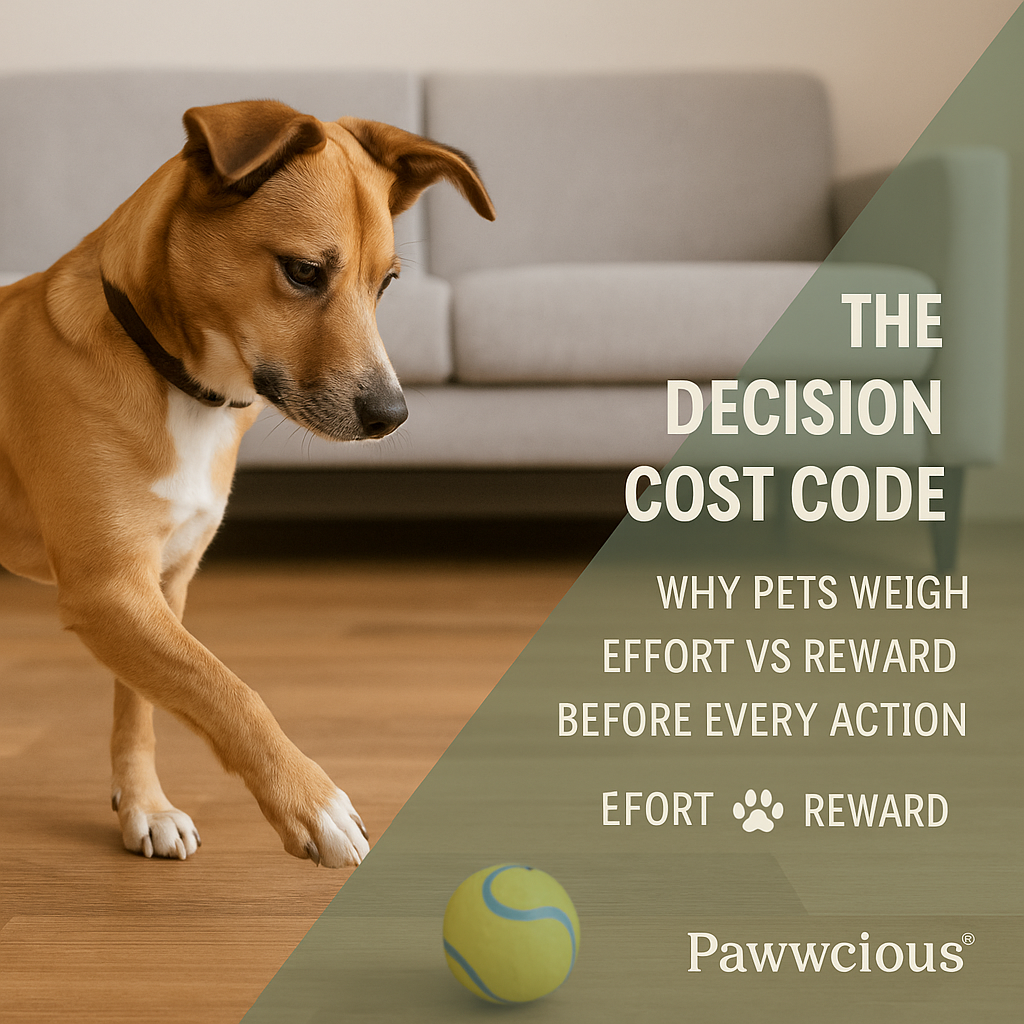
Every action your pet takes — jumping on the bed, walking toward you, asking for food, chasing a toy — is not random.
Before moving, your pet’s brain performs a rapid effort–reward calculation called cognitive cost evaluation.
In milliseconds, they judge:
- Is the reward worth the energy?
- Is the distance worth the effort?
- Is the outcome predictable?
- Will I succeed without discomfort?
This hidden decision-making science is called pet cognitive economics.
Let’s decode how your pet “thinks in costs.”
⚡ 1. Effort Budget: Pets Conserve Energy Strategically
Pets subconsciously track how much energy they have for:
- play
- social interaction
- exploration
- alertness
If their internal “energy budget” is low, they skip optional actions.
🎯 2. Reward Value: What Your Pet Truly Thinks Is Worth It
Pets evaluate rewards by:
- emotional value
- food value
- bonding value
- novelty value
- predictability
A treat + your attention often outweighs physical effort.
🐾 3. Distance Mathematics: Closer Rewards Feel Bigger
A toy 10 feet away feels “less rewarding” than one 2 feet away — even if identical.
Your pet weighs:
- distance
- terrain
- obstacles
- risk
All inside a micro-calculation loop.
🪑 4. Physical Difficulty: Body Awareness Shapes Choices
Jumping on a high sofa?
Your pet evaluates:
- joint load
- surface stability
- landing confidence
If the surface seems risky, they abandon the attempt — a logical decision, not laziness.
🔄 5. Success Prediction: Pets Simulate the Outcome
Their brain rehearses possibilities:
- “Will I reach it?”
- “Will it fall?”
- “Will I slip?”
If outcome uncertainty is high → the action is skipped.
❤️ Conclusion
Your pet is not being stubborn or lazy — they’re brilliant risk managers.
Understanding the Decision Cost Code helps you create environments where actions “feel cheaper” and rewards “feel richer.”
🌿 CTA
Empower your pet’s natural decision patterns with Pawwcious® sensory-friendly products, calming aids, and smart enrichment tools.
👉 www.pawwcious.com