
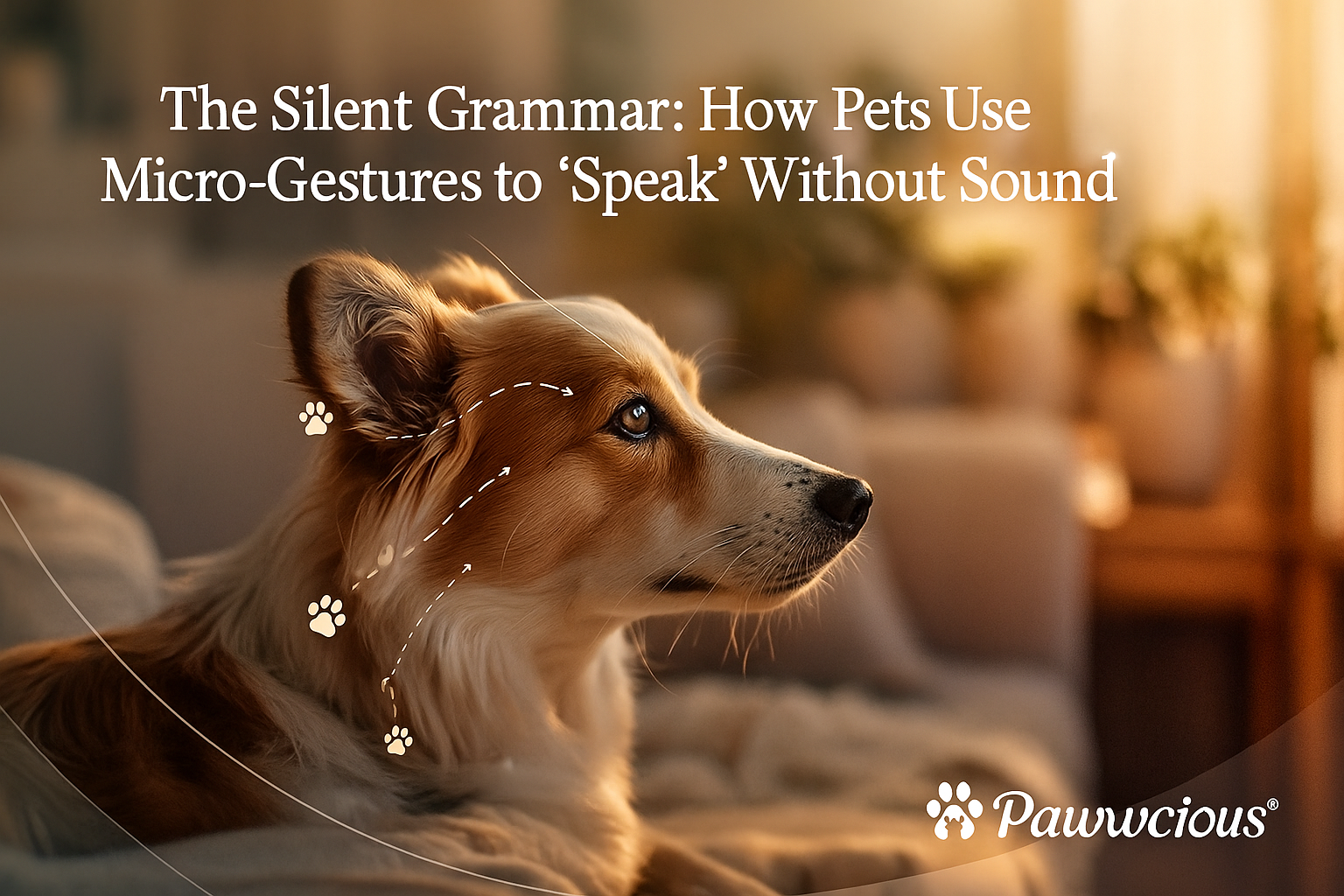
Pets communicate far more than we think — and surprisingly, they do it through a silent grammar of micro-gestures.
Unlike vocal commands or obvious body language, micro-gestures are tiny signals:
eye flicks, whisker shifts, ear angles, paw adjustments, tail-tip vibrations, weight shifts.
These aren’t random.
They follow patterns… rules…
a structure similar to grammar in human language.
This Pawwcious® guide uncovers how your pet has been “speaking” to you all along — quietly, consistently, and intelligently.
👁️ 1. The Eye-Flick Syntax: Direction + Intention
A quick sideways eye flick tells you:
- what they want you to look at
- what they’re anticipating
- their next predicted movement
It’s their version of punctuation.
👂 2. Ear-Tilt Grammar: Question Marks & Alerts
A single ear tilt = curiosity.
A backward micro-tilt = uncertainty.
A sharp angle = alert.
Pets use ears like commas and exclamation marks.
🐾 3. Paw-Shift Signals: Emotional Modifiers
One subtle paw lift means:
- hesitation
- request
- negotiation
A slow paw press on your foot = reassurance.
These micro-signals modify emotional context — just like adverbs.
🐕🦺 4. Weight Distribution: Statements vs. Questions
- Forward weight = “I want something.”
- Backward weight = “Should I?”
- Side weight = “What’s happening?”
This is sentence structure — subject + intent.
🐈 5. Tail-Tip Vibrations: Hidden Vocabulary
A vibrating tail-tip (not wagging) conveys:
- thrill
- high focus
- anticipation
- attention lock
Cats and dogs both use this, but differently.
💬 Conclusion
Your pet is not just reacting.
They’re speaking, using a micro-language built from evolution, instinct, and emotional nuance.
If you listen with your eyes,
you’ll hear them perfectly.
🌿 CTA
Strengthen your silent communication by supporting your pet’s emotional clarity with Pawwcious® herbal calming and wellness essentials.
👉 www.pawwcious.com