
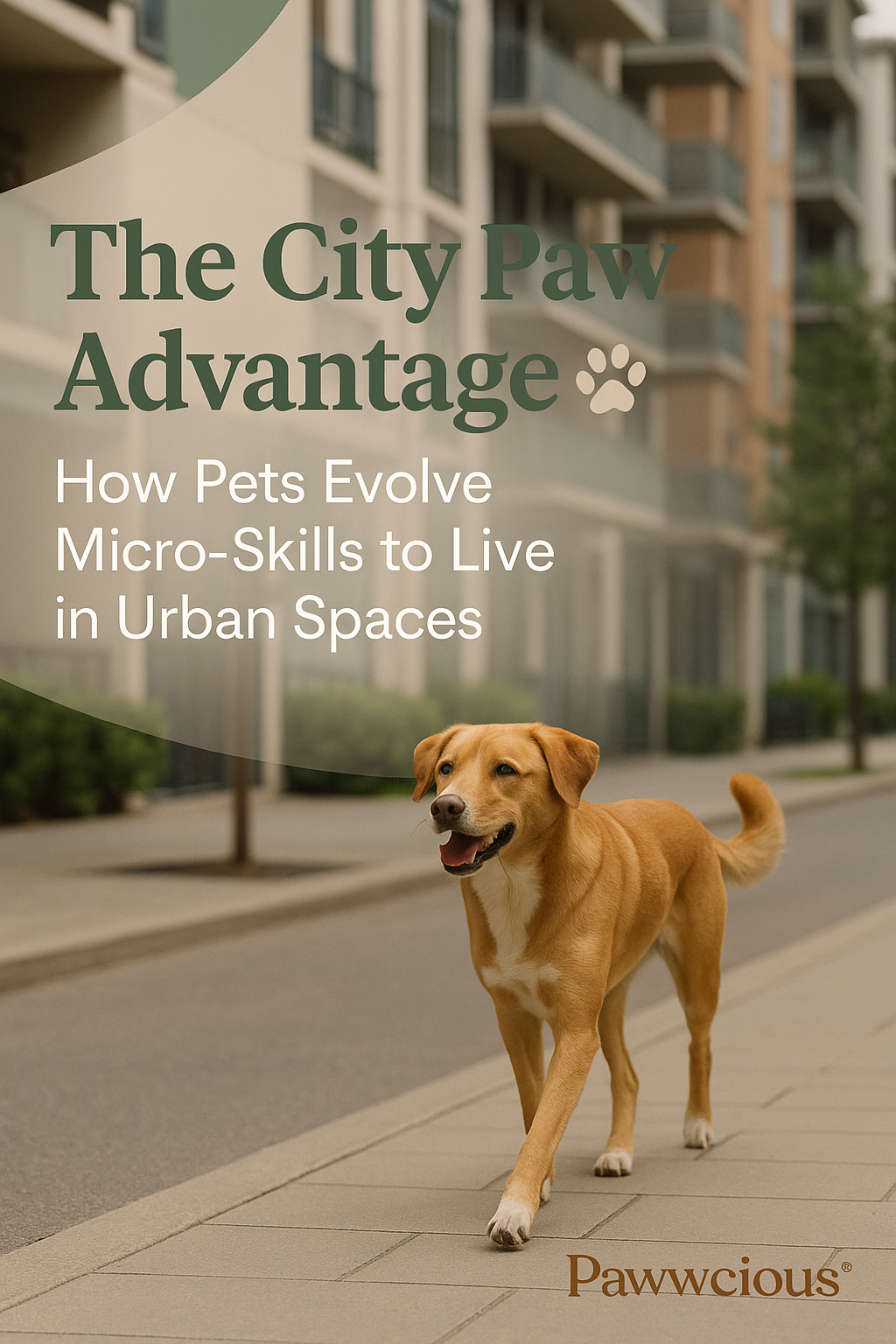
City life isn’t just a lifestyle — it’s an adaptive ecosystem.
And whether you notice it or not, your pet has been quietly evolving micro-skills to survive, navigate, and thrive in urban spaces.
Just like urban wildlife learns to adapt to traffic, crowds, noise layers, and artificial lighting, our pets develop subtle behaviors that rural or suburban pets never need.
This Pawwcious® guide explores the fascinating, modern-day evolution happening right under our noses — inside apartments, elevators, high-rise corridors, and bustling city lanes.
🚦 1. Elevator Intelligence: Understanding Vertical Movement
Pets born in cities learn that “movement” doesn’t only mean walking.
Micro-skills developed:
- Knowing when the lift door is about to open
- Anticipating stops by posture shifts
- Remaining still during vertical travel
- Recognizing familiar floors by smell + vibration memory
This is a uniquely urban adaptation — like learning a new sensory language.
🔊 2. Noise Filtering: The Urban Sound Sorting System
Cities are loud.
But your pet doesn’t panic at every noise — because they learn noise hierarchy.
Skills they subconsciously develop:
- Ignoring low-priority sounds (vehicles, honks, conversations)
- Reacting only to meaningful cues (your footsteps, your key turning, your voice)
- Distinguishing “danger” sounds vs. “ambient” sounds
- Filtering layered noises into categories
City pets essentially build a mental “sound inbox.”
🏙️ 3. Balcony Awareness: The Edge-Sense Adaptation
Unlike rural dogs, city pets develop perception of edges, heights, and drop-offs.
Micro-skills:
- Maintaining distance from balcony railings
- Learning safe vantage points
- Adjusting body position near edges
- Understanding vertical depth
This is an advanced spatial adaptation that shows real cognitive adjustment.
🚶 4. Pavement Reading: Paw-Level Urban Mapping
City pathways include:
- Tiles
- Asphalt
- Manholes
- Slippery stone
- Hot pavements
- Broken patches
Pets learn to avoid certain textures, slow down on risky surfaces, and pick stable walking zones.
City walks build:
- Reflexive foot placement
- Hot-surface awareness
- Obstacle prediction
- Traffic-side positioning
This is biomechanical intelligence in action.
🌃 5. Light-Cue Learning: Recognizing City Rhythms
Urban nightlife has predictable patterns:
streetlights → vehicle headlights → shop shutters → elevator indicators.
Pets learn to:
- Move during low-stimulation times
- Recognize evening settling cues
- Predict when it’s time for walks or meals
- Respond to indoor/outdoor light patterns
This becomes part of their daily urban circadian rhythm.
🚌 6. Crowded-Space Navigation
City pets master micro-movements around groups of people.
They learn how to:
- Walk between legs
- Pause for approaching people
- Move to the “safer side” of the parent
- Adjust speed to match crowds
This is the urban version of herd-navigation evolution.
🏡 7. Apartment Territory Micro-Mapping
City homes are compact, so pets create micro-territories instead of large zones.
They learn:
- Elevated spots as lookout points
- Corners as safety pockets
- Window edges as scent-screens
- Doorways as “alert stations”
This turns your apartment into a well-defined mental map.
💛 Conclusion
City pets aren’t just adapting — they are evolving micro-skills that shape how they think, move, sense, and behave.
These skills make them intelligent, aware, and harmoniously synced with modern environments.
At Pawwcious®, we celebrate these little evolutionary victories — because every adaptation is a sign of growth, confidence, and emotional balance.
Your pet is not just surviving the city.
They’re mastering it.
🌿 Call to Action (CTA)
Support your city pet’s adaptive journey with Pawwcious® natural calming, grooming, and wellness essentials—crafted for modern environments.
👉 www.pawwcious.com