Your pet’s tail isn’t just adorable — it’s a genetic blueprint.
The curl, length, thickness, flexibility, and posture of a tail reveal powerful clues about your pet’s ancestral story. Long before modern breeds existed, tail structures evolved for survival: balance, communication, climate adaptation, and movement through different terrains.
In this Pawwcious® guide, let’s decode the Tail Code — the hidden evolutionary messages written in the shape of your pet’s tail.
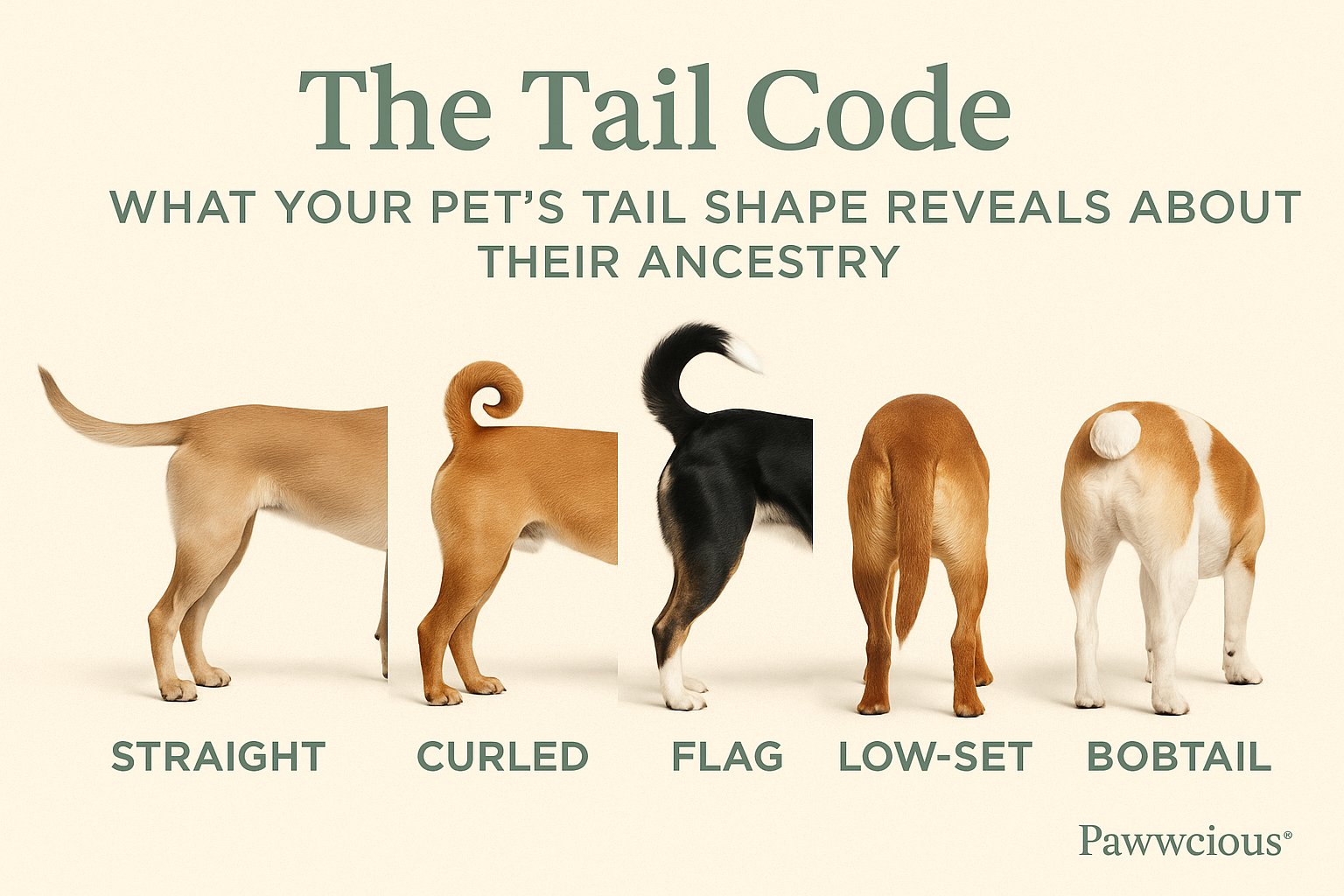
🐕🦺 1. The Straight Tail — The Tracker Lineage
Seen in: German Shepherds, Labradors, Indies, Beagles
Straight tails evolved among tracking and hunting lineages.
🧬 What it reveals about ancestry:
- Designed for directional signaling during group hunts
- Helps maintain aerodynamic balance
- Shows lineage from wolves and field-running breeds
Straight tails = active, alert, movement-focused ancestry.
🌀 2. The Curled Tail — The Arctic & Mountain Heritage
Seen in: Pugs, Akitas, Shiba Inu, Huskies, Spitz breeds
Tightly curled tails developed in cold, snowy regions.
🧬 What it reveals:
- Curling helps conserve heat by protecting the nose during sleep
- Indicates northern ancestry
- Associated with high stamina and thick-coated breeds
A curled tail = ancestors built for harsh climates and long journeys.
🚩 3. The Flag Tail — The Communicator Line
A tail that lifts high like a flag indicates ancestry tied to herding or alert roles.
Seen in:
Collies, Border Collies, Belgian Malinois
🧬 Tail Code meaning:
- High tail posture = quick signaling ability
- Helps guide livestock
- Shows strong visual communication lineage
These pets inherited a tail built for leadership and coordination.
🌿 4. The Low-Set Tail — The Stealth Lineage
Seen in: Hounds, Retrievers, Sighthounds
A lower tail carriage evolved for silent movement in forests and fields.
🧬 This means:
- Ancestry in stealth or scent-tracking roles
- Conserves energy while running
- Reduces visibility to prey
Low-set tail = hunting & stealth ancestry.
🐈 5. The Whip Tail — The Speed Line
Thin, elongated tails are found in breeds built for speed.
Seen in: Greyhounds, Whippets, many cats
🧬 Tail Code meaning:
- Acts as a rudder during rapid movement
- Helps change direction instantly
- Indicates desert or plains ancestry
Whip tails = sprinter genetics.
🧸 6. The Bobtail — The Mutation Lineage
Some pets are naturally bobtailed, not docked.
Seen in: Australian Shepherds, French Bulldogs, Corgis
🧬 What it reveals:
- Caused by a dominant gene mutation (T-box gene)
- Historically linked to working dogs to prevent tail injuries
- Indicates unique genetic diversity
A natural bobtail = rare mutation passed through ancestry.
🐾 7. The Feathered Tail — The Water & Field Lineage
Long, flowing hair on the tail shows heritage linked to retrieving work.
Seen in: Golden Retrievers, Spaniels
🧬 Meaning:
- Tail acts like a rudder in water
- Helps maintain stability while swimming
- Indicates ancestry connected with lakes, rivers & marshlands
Feathered tails = water-worker lineage.
🧠 What Your Pet’s Tail Says About Their Personality
While tail shape is genetic, it subtly influences behavior patterns:
- Straight tails → confident, alert
- Curled tails → observant, routine-oriented
- Whip tails → energetic, fast responders
- Low-set tails → gentle, quiet, sensitive
Tails are evolution’s handwriting — and your pet carries it proudly.
💚 Conclusion
Your pet’s tail is much more than an expressive tool — it’s a window into their past.
By decoding its shape, posture, and structure, you are reading a living story of their evolutionary journey.
At Pawwcious®, we believe understanding a pet’s heritage deepens the bond — because every detail, from fur to tail, tells a story.
🌿 Pawwcious® Call to Action
Honor your pet’s ancestry with natural wellness that matches their innate needs.
Explore our organic grooming, calming, and herbal care essentials.
👉 www.pawwcious.com